Germany · Weimar · 4 pictures
Weimar Historic Cemetery
Historischer Friedhof

About this place
The old Jakobskirchhof was no longer large enough, so the New Cemetery outside the Frauentor was built between 1814 and 1818 and consecrated on 20 March 1818. From 1862 it was extended south and west to become the main cemetery. To this day nobody is buried north of the Fürstengruft, so that the park-like view is preserved.
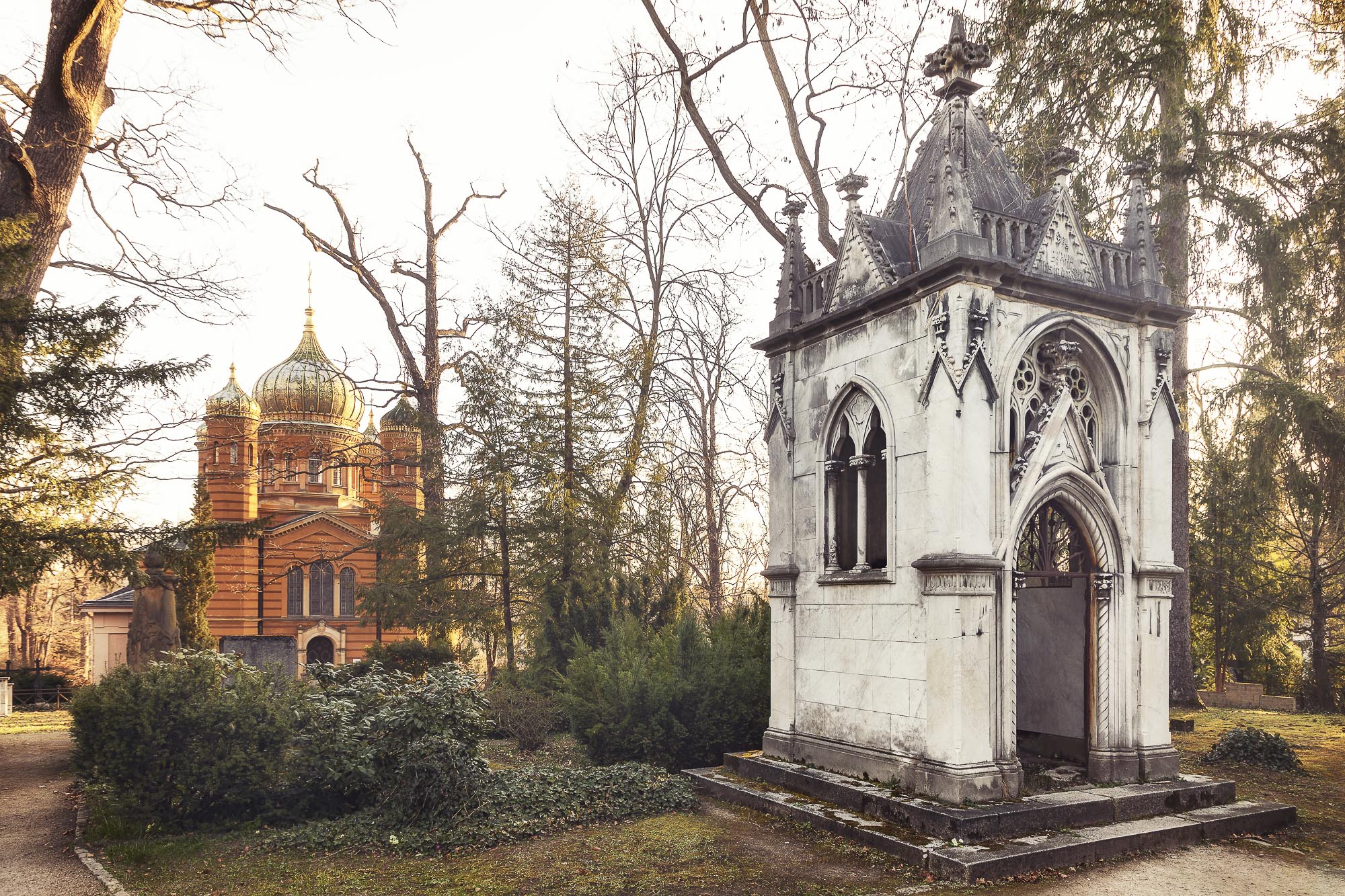
The Fürstengruft was built between 1823 and 1828 to designs by Clemens Wenzeslaus Coudray. It is the burial place of the grand-ducal house, and at the wish of Grand Duke Carl August Goethe and Schiller were also given a place here. Goethe was interred in 1832; Schiller's coffin is now regarded as symbolic, because his remains cannot be identified with certainty. On the back wall of the vault stands the Russian Orthodox Chapel, built over the grave of Grand Duchess Maria Pavlovna.
Elsewhere on the grounds lie Charlotte von Stein, the composer Johann Nepomuk Hummel, Goethe's assistant Johann Peter Eckermann and the poet Ernst von Wildenbruch. The Euphrosyne monument and the monument to the fallen of the March revolution can also be seen.
The cemetery is protected as a cultural and garden monument and invites a walk through a hundred years of Weimar's culture of remembrance.
Frequently asked questions
Where is the Historischer Friedhof in Weimar?
The cemetery lies on a hill in the south-west of Weimar's town centre, beside the Poseckscher Garten. The Fürstengruft stands on its grounds.
Are Goethe and Schiller buried at the Historischer Friedhof?
Goethe was interred in the Fürstengruft in 1832. Schiller's coffin is there too, but it is regarded as symbolic because his remains could not be identified with certainty.
Why is the Weimar Historic Cemetery well known?
It is the burial place of the House of Saxe-Weimar-Eisenach with the Fürstengruft, and since 1998 it has been part of the UNESCO World Heritage ensemble Classical Weimar.